
Precision Hot Runner Mold Tooling for High-Volume Production
CNMOULDING (Shanghai) designs and manufactures high-precision hot runner molds for automotive, medical, and technical electronics industries. We specialize in optimizing thermal balance, gate integrity, and cavity consistency to support stable, continuous mass production.
Our engineering team focuses on eliminating common hot runner failures—such as leakage, gate freeze, and thermal degradation—through rigorous Moldflow simulation, thermal calculation, and precision CNC/EDM steel processing.
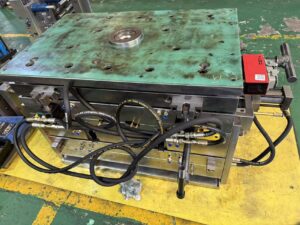
Precision Hot Runner Mold Manufacturing in China
Technical Capabilities in Hot Runner Mold Design
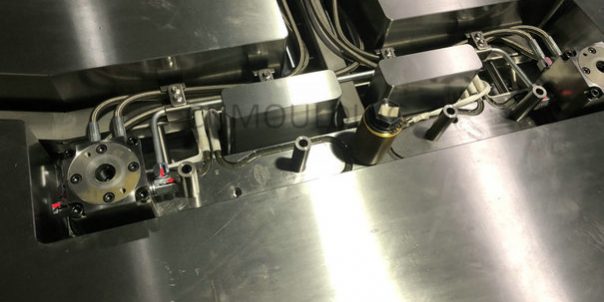
Successful execution of a hot runner mold relies on rigorous thermal separation and precise mechanical alignment between the hot runner system and the mold plates.
Thermal Management & Insulation: Precise calculation of thermal expansion to ensure perfect alignment of nozzle tips to gate inserts at operating temperatures. Integrated titanium insulation boards and optimized air gaps minimize heat loss to the mold plates.
Manifold and Flow Channel Balancing: Rhombus or natural-balanced manifold layouts with polished runner channels to prevent material stagnation, shear heating, and pressure drops across multi-cavity configurations.
High-Cavitation Tooling: Engineering and manufacturing of multi-cavity injection molds (up to 64 cavities) ensuring uniform filling balance and weight consistency (pm0.5% variation cavity-to-cavity).
Resin-Specific Nozzle Selection: Custom selection of open gates, valve gates, or edge gates based on resin characteristics (e.g., glass-filled PA66, highly corrosive PPS, thermally sensitive PC/ABS, or high-temperature PEEK).
Valve Gate Hot Runner Systems
For cosmetic Class-A surfaces and tight dimensional tolerances, we engineer pneumatic or hydraulic valve gate hot runner molds to achieve optimal process control.
Gate Vestige Control: Valve pin geometry is precisely matched with the gate insert to ensure a flush, clean break with minimum gate vestige (<0.1\mm}).
Sequential Valve Gating (SVG): Implementation of timed pin opening sequences to eliminate weld lines and control the filling pattern of large automotive components or complex housings.
Cylinder and Pin Alignment: Hardened valve pin guides and bush inserts prevent misalignment, reducing wear and eliminating the risk of pin sticking during high-cycle production.
Tooling Challenges Resolved by Engineering
We mitigate production instability through advanced DFM analysis and precision machining before steel cutting begins.
| Technical Challenge | Engineering Prevention Strategy |
| Material Degradation / Discoloration | Optimizing runner diameters and internal radii to prevent dead spots; implementing precise multi-zone PID temperature control. |
| Drooling / Stringing | Advanced thermal profile simulation at the nozzle tip; precise cooling channel layout around the gate area for rapid gate freeze. |
| Nozzle/Manifold Leakage | Exact calculation of hot-state sealing pressure; precision grinding of backing pads and pressure plates to strict tolerance specs. |
| Unbalanced Cavity Filling | Moldflow runner balancing matched with actual shear-thinning behavior of the specified resin grade. |
Moldflow Simulation & Structural DFM
Every hot runner mold project undergoes mandatory engineering verification during the design phase:
Rheological Analysis: Evaluation of shear rate, volumetric shrinkage, and packing pressure distribution.
Thermal Deflection Analysis: Simulating the temperature gradient across the core and cavity plates to optimize cooling line placement (1.2344 / 1.2343\ESR steel with conformal cooling where necessary).
Clamping Force & Deflection: Checking mold base rigidity under peak injection pressure to prevent flash or micro-deflections at the parting line.
Strict Manufacturing Tolerances
Operating from our Shanghai facility, we process mold components to internal precision standards:
Hot Runner Pocket Depth: ±0.01 mm
Gate Insert Alignment: ±0.005 mm
Nozzle Tip Concentricity: Within 0.01 mm to the gate center
Core/Cavity Interchangeability: ±0.005 mm utilizing high-speed CNC and high-precision EDM processing.
Mold Validation and T1 Protocols
Our mold trial procedure for hot runner tools follows a strict engineering checklist rather than basic sampling:
Thermal Soak Test: Running the hot runner system at processing temperature for a minimum of 2 hours to verify thermal stability and check for leakage or structural interference.
Short-Shot Balance Test: Running a series of short shots with the hot runner system to evaluate the actual filling balance across all cavities without packing pressure.
Pressure Drop Evaluation: Measuring the hydraulic pressure required to push material through the hot runner vs. the complete tool.
Cooling Efficiency Log: Monitoring Delta T between cooling inlets and outlets to ensure uniform heat dissipation across both hot runner plates and cavity inserts.
Technical Specifications
Mold Base Steel: HASCO, LKM, or DME standards (1.1730, 1.2311, 1.2738)
Core/Cavity Steel: 1.2344 ESR, 1.2343 ESR, S136 ESR (hardened to HRC 48–52 or HRC 52–54)
Hot Runner Integration: Synventive, Mold-Masters, Yudo, Husky, Incoe, or HRSflow (per customer global standard specification)
In-house Machining Capacity: High-speed CNC (20,000 RPM), Charmilles EDM, Sodick Wire EDM, Hexagon CMM Inspection.
Engineering Inquiry Support
For direct technical evaluation or DFM assessment of your hot runner mold project, please submit your 3D data (STEP/X_T) and resin specifications to our engineering office.
Technical Response: 24 Hours
DFM Delivery: 2–3 Working Days
Location: Shanghai, China
Contact: webmaster@cnmoulding.com | +86-21-52913487