
Selecting the Right Plastic Molding Process: A B2B Procurement &
Engineering Guide
Choosing the Right Plastic Molding Process Matters
Selecting the right plastic molding process has a major impact on:
- Manufacturing cost
- Tooling investment
- Product quality
- Production speed
- Material selection
- Surface finish
- Long-term scalability
Many product development problems are caused by selecting the wrong manufacturing process too early.
At CNMOULDING, we help customers evaluate molding methods based on:
- Part geometry
- Production volume
- Cosmetic requirements
- Mechanical performance
- Tooling budget
- Lead time
- Assembly requirements
Different plastic molding technologies are suitable for very different production scenarios. The best process is not always the most advanced one — it is the one that fits the product and production strategy best.
1. Injection Molding: High-Precision, High-Volume
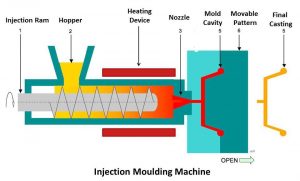
Procurement Decision: Best for complex, high-precision structural parts with annual volumes exceeding 5,000 units. Requires high upfront tooling investment.
Engineering Challenge: Managing polymer behavior under intense pressure. Non-uniform wall thicknesses cause differential shrinkage, leading to sink marks or warpage. Precise thermal balancing of the injection mold design and hot runner system is mandatory to prevent material degradation.
Cost Logic: High upfront capital, but the lowest piece-part cost due to fast cycle times (15–45s). Amortization drastically drops unit costs as volume scales:
Real Case: An automotive client faced severe warpage and brittle snap-fits on an internal bracket from a previous supplier. By optimizing gate locations and cooling lines via Moldflow analysis and using premium steel inserts, we eliminated internal molded-in stress to deliver flat, high-tolerance ($\pm0.02\text{ mm}$) parts.
2. Blow Molding: Hollow-Core Structural Integrity
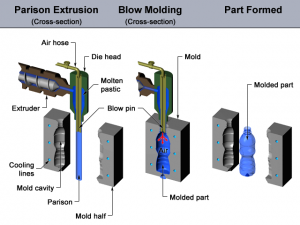
Procurement Decision: Best for hollow, single-piece geometries (tanks, bottles, large enclosures). Procurement must monitor parison weight consistency to prevent thin spots.
Engineering Challenge: Relies on low pressure to expand a molten parison. Deep-drawn areas stretch material thin, causing corner thinning. Requires generous radii and dynamic parison programming to maintain impact resistance.
Cost Logic: Tooling costs are significantly lower than injection molds because the cavity requires no complex core slider mechanism—air pressure creates the internal geometry.
Real Case: A medical client’s two-piece injection-molded fluid container repeatedly leaked at the glued seams. We transitioned the project to an HDPE blow molding process, creating a seamless hollow body that cut tooling costs by 60% and eliminated leakage.
3. Thermoforming: Large Scale, Low Upfront Investment
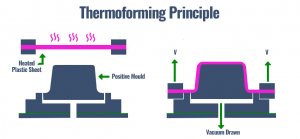
Procurement Decision: Best for large-surface-area panels, medical housings, and vehicle dashboards at low-to-medium volumes (100–3,000 units/year).
Engineering Challenge: Heated plastic sheets are stretched over a mold using a vacuum. Deep parts suffer from material thinning due to the draw ratio. Internal ribs or sharp boss towers cannot be molded-in and require secondary CNC machining or bonding.
Cost Logic: Low tooling investment (aluminum or composite molds), making it ideal for rapid market entry or large components where an injection mold is financially prohibitive.
Real Case: An industrial diagnostics company needed large protective panels for 500 medical scanners annually. Injection tooling was quoted at over $200,000. We engineered a heavy-gauge ABS thermoforming tool for under $15,000 and used 5-axis CNC routing for post-forming cutouts, achieving an injection-molded look at a fraction of the cost.
4. Compression Molding: High-Strength Thermosets & Composites
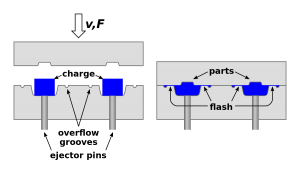
Procurement Decision: Best for high-strength, heat-resistant components utilizing thermosetting plastics or composites (gaskets, brake pads, electrical insulators).
Engineering Challenge: Raw material cures permanently under heat and hydraulic pressure. Uneven mold temperatures or rapid closing cause the material to pre-cure, resulting in internal voids or “short shots.”
Cost Logic: Robust, straightforward tooling without complex gating mechanisms. However, long curing cycles (several minutes) yield higher piece-part labor costs.
Real Case: A heavy-duty electrical grid component molded from thermoplastics repeatedly melted under high voltage field tests. We developed a compression mold using a Sheet Molding Compound (SMC) thermoset. The cross-linked material easily withstood temperatures exceeding 200°C without deformation.
Comparison of the 4 Plastic Molding Processes
| Process | Main Advantages | Main Limitations | Best Production Volume | Typical Applications |
|---|---|---|---|---|
| Injection Molding | Precision, automation, complex geometry | High tooling cost | Medium to High Volume | Automotive, medical, electronics |
| Blow Molding | Efficient hollow part production | Limited precision | High Volume | Bottles, tanks, packaging |
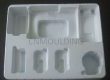
| Thermoforming | Low tooling cost, large parts | Lower dimensional accuracy | Low to Medium Volume | Trays, panels, enclosures |
| Compression Molding | High structural strength | Slower production | Medium Volume | Composite & thermoset parts |
Our Factory Capabilities
Operating out of our precision facility in Shanghai since 1997, we specialize in high-precision injection mold design and manufacturing for global markets.
Micron Precision: High-speed CNC and precision EDM achieving tool tolerances down to $\pm2\,\mu\text{m}$.
DFM Engineering: Comprehensive Moldflow evaluation before steel cutting to eliminate warpage and sink marks.
Global Standards: Molds built strictly to HASCO/DME standards for seamless export or localized injection production.
CNMOULDING provides:
- Injection molding
- Thermoforming
- Vacuum forming
- Precision mold manufacturing
- DFM engineering support
- Prototype & mass production solutions
Our engineering team helps customers select the most cost-effective and production-stable manufacturing process based on real project requirements.
Contact us today for technical evaluation and quotation support.
- 24-Hour Engineering Response
- Precision Manufacturing Capability
- Competitive Tooling Cost
- Stable Production Quality
- Worldwide Export Support
Email: webmaster@cnmoulding.com
Phone: +86-21-52913487