
Precision Injection Molding for New Energy Vehicles (NEVs): Engineering,
Cost, and Procurement Strategy
The rapid transition toward New Energy Vehicles (NEVs) has fundamentally shifted automotive engineering requirements. Weight reduction is no longer just about fuel economy—it directly dictates battery range. Concurrently, high-voltage vehicle architectures (up to 800V) demand unprecedented flame retardancy and dielectric insulation.
For automotive procurement managers and Tier 1 engineers, sourcing precision plastic components is a multi-dimensional challenge balancing material physics, complex injection mold design, and strict quality control.
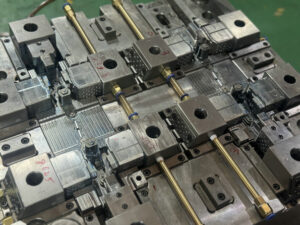
Automotive Injection Molding Parts | CNMOULDING China
1. Battery Pack Components: Flame Retardancy & Dielectric Strength
The Procurement Decision
Application: Battery cell spacers, module brackets, insulation plates, and top covers.
Risk Mitigation: Procurement must source suppliers capable of processing highly filled, flame-retardant resins (e.g., PA66+GF30 with UL94-V0 rating). Tooling suppliers must guarantee long-term mold life against highly abrasive glass fibers.
The Engineering Challenge
Flame-retardant additives and glass fiber reinforcement drastically alter resin rheology. Glass fibers cause highly anisotropic shrinkage (shrinking differently along the flow direction vs. cross-flow), causing severe part warpage. Furthermore, improper injection mold design can lead to visible knit lines, significantly reducing the mechanical strength of structural module brackets.
The Cost Logic
While UL94-V0 engineered resins carry a premium price per kilogram, true cost savings are found in tool layout and cycle efficiency. Designing multi-cavity hot runner molds minimizes sprue scrap—a crucial factor when processing expensive specialized polymers.
Real-World Case Study
The Project: A European Tier 1 supplier required a thin-walled, multi-cell battery spacing bracket with strict flatness tolerances within $0.05\text{ mm}$.
The Failure: The previous manufacturer used an incorrectly balanced cold runner system, resulting in severe fiber orientation issues, asymmetric warpage, and cell-fitting failures during assembly.
The Solution: We re-engineered the tool with a hot-to-cold runner system using sequential valve gating. Combined with advanced Moldflow analysis, we optimized the cooling lines to achieve perfectly uniform shrinkage, completely eliminating warpage and achieving zero-defect automated battery assembly.
2. E-Powertrain & Thermal Management: High Heat & Chemical Resistance
The Procurement Decision
Application: Electric motor terminal blocks, inverter housings, cooling fluid valves, and electronic water pumps.
Risk Mitigation: Components operate under continuous exposure to high temperatures (up to 150°C) and corrosive glycol-based coolants. Procurement must verify that the molding partner has rigid process controls to prevent flash and dimensional drift over long production runs.
The Engineering Challenge
Resins like PPA, PPS, or specialized PA612 require high mold temperatures (often exceeding 140°C) to achieve full crystallinity. If the mold temperature is too low, the molded parts will undergo post-crystallization in the vehicle, leading to unexpected dimensional shrinkage and catastrophic coolant leaks.
The Cost Logic
Tooling for high-temperature resins requires specialized tool steel (e.g., hardened H13 or 2344) and advanced thermal insulation boards. Although initial tooling costs increase by 20% to 30%, it prevents premature mold wear, downtime, and the massive financial liabilities associated with field recalls.
Real-World Case Study
The Project: An electric drive cooling control valve body requiring tight sealing threads and high pressure resistance.
The Failure: The component suffered from thread deformation and micro-voids in thick sections, causing pressure loss during hot-coolant validation cycles.
The Solution: We utilized an internal gas-assisted injection molding strategy and added conformal cooling channels inside the mold core inserts. This eliminated internal volumetric shrinkage voids, guaranteed perfect thread integrity, and trimmed the production cycle time by 18%.
3. ADAS & Electronic Modules: Dimensional Stability & Shielding
The Procurement Decision
Application: Radar/LiDAR brackets, camera housings, sensor enclosures, and Electronic Control Unit (ECU) covers.
Risk Mitigation: These components house delicate electronics. The molding partner must maintain micron-level accuracy across fluctuating seasonal production runs to ensure airtight, waterproof seals (IP67/IP69K).
The Engineering Challenge
ADAS components are frequently exposed to external impacts and harsh weather, requiring high-impact plastics like PC/PBT blends. Engineering a mold for these housings demands precise gate sizing to minimize shear stress, which otherwise causes micro-cracking around critical metal insert pins over time.
The Cost Logic
To achieve watertight sealing, automated overmolding (two-shot or insert molding) is highly economical compared to secondary manual gluing or ultrasonic welding. It eliminates manual labor costs and completely removes human error variables from the assembly chain.
Real-World Case Study
The Project: A waterproof rear-view camera housing with integrated metal grounding pins.
The Failure: Manual assembly of a silicone gasket consistently resulted in a 3.5% failure rate during pressure leak testing.
The Solution: We designed an automated insert-molding process where the metal pins are positioned via robotics, followed by secondary overmolding of a TPE sealing lip directly onto the rigid PC housing. The assembly scrap rate dropped to exactly 0%.
Summary NEV Injection Molding Matrix
| Component Category | Primary Resins | Critical Procurement Risk | Tooling & Process Engineering Solution |
| Battery Modules | PA66+GF30 (V0), PBT | Fiber-induced warpage, weak knit lines | Sequential valve gating, optimized injection mold design |
| Thermal Components | PPA, PPS, PA612 | Post-molding shrinkage, coolant leaks | Oil-heated high-temp molds ($>140^\circ\text{C}$), conformal cooling |
| ADAS & Sensors | PC/PBT, PBT+GF | Water ingress, insert cracking | Automated insert molding, low-shear gate designs |
Our Factory Capabilities in Shanghai
With nearly three decades of specialized experience since 1997, our Shanghai-based facility delivers the engineering excellence required by the fast-moving global NEV sector.
Automotive Grade Engineering: We operate under strict IATF 16949 quality guidelines, utilizing advanced Moldflow simulation to troubleshoot warpage, gas traps, and gate locations before tool steel is cut.
Advanced Toolroom Equipment: Equipped with high-speed Makino CNC centers and Charmilles EDM machines capable of achieving structural tolerances down to $\pm0.01\text{ mm}$ for multi-cavity automotive components.
Overmolding & Insert Molding Expertise: Fully automated production cells featuring robotic insert placement and two-shot molding capabilities to ensure perfect repeatability for Tier 1 programs.
Contact our engineering division today to submit your 3D CAD files for a comprehensive Design for Manufacturing (DFM) review and optimize your NEV tooling pipeline.