

Solving Cracking Issues in ABS Parts with Copper Inserts: A Root Cause Analysis
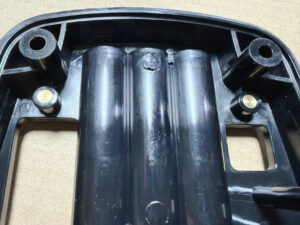
Insert molding ABS with copper bushings is a common practice for creating durable threads in plastic parts. However, many manufacturers struggle with delayed cracking (stress cracking) around the metal insert, often appearing weeks after production.
As a precision mold maker in Shanghai, CNMOULDING has analyzed hundreds of failed components. This guide breaks down why these cracks happen and the specific engineering solutions we implement to prevent them.
Solving Cracking Issues in ABS Parts with Copper Inserts
1. The Root Cause: Thermal Expansion Mismatch
The Problem: ABS and Copper have vastly different Coefficients of Thermal Expansion (CTE). Copper expands and contracts much less than plastic. When the hot ABS melt (approx. 230°C) hits a cold copper insert, the plastic quickly “freezes” around the metal. As it continues to cool to room temperature, the ABS tries to shrink, but the rigid copper insert resists this shrinkage, creating massive hoop stress.
2. Engineering Solution: Pre-Heating Protocols
The Challenge: Cold inserts act as a “heat sink,” causing a thin layer of plastic to solidify instantly (the skin layer), which traps internal stress.
Our Solution:
Insert Pre-heating: We recommend pre-heating copper inserts to 60°C – 100°C before loading them into the mold. This reduces the temperature delta between the melt and the metal, allowing the ABS to cool more uniformly and reducing the initial stress load.
3. Engineering Solution: Material & Wall Thickness Optimization
The Challenge: If the plastic wall surrounding the insert is too thin, it cannot withstand the internal tension and will eventually “snap.”
Our Solution:
The 2:1 Rule: For ABS, we generally design the plastic wall thickness to be at least 2 times the radius of the insert.
Grade Selection: Not all ABS is equal. We steer clients toward high-flow, high-impact grades with better chemical resistance, as standard ABS is highly susceptible to Environmental Stress Cracking (ESC).
4. Engineering Solution: Insert Geometry & Knurling Design
The Challenge: Sharp corners on the metal insert act as “stress concentrators,” where cracks almost always originate.
Our Solution:
Rounded Shoulders: We specify copper inserts with radiused edges rather than sharp 90-degree steps.
Optimized Knurling: We recommend diamond or helical knurling with rounded valleys. Sharp, deep straight knurls create “notch sensitivity” in the plastic, significantly increasing the risk of failure.
5. Engineering Solution: Post-Molding Annealing
The Challenge: Even with perfect design, some residual stress is inevitable in complex parts.
Our Solution:
Stress-Relief Annealing: For critical components (like automotive or medical housings), we implement a post-molding annealing process. Placing parts in a temperature-controlled oven (approx. 70°C-80°C for 2-4 hours) allows the polymer chains to relax, effectively “baking out” the internal stress before the parts are shipped.
Why DFM is Critical for Insert Molding
At our Shanghai facility, we don’t just wait for cracks to happen. We use Moldflow Analysis to predict high-stress areas before the mold is even built.
Our DFM check for inserts includes:
Weld Line Placement: Ensuring weld lines (the weakest part of the plastic) do not form directly adjacent to the metal insert.
Injection Pressure Calibration: Optimizing packing pressure to ensure the insert is fully encapsulated without over-stressing the material.
Stop the Scrap: Partner with CNMOULDING
Are your ABS parts failing in the field? Don’t let a simple copper insert ruin your product’s reputation.
Based in Shanghai, CNMOULDING specializes in solving complex molding failures. Upload your 3D CAD files today for a professional Stress-Point Analysis and DFM review.