
PC (Polycarbonate) Plastic Injection Molding Processing Technology
Polycarbonate (PC)—commonly referred to in China as “bulletproof plastic” due to its exceptional impact resistance—is an amorphous, high-performance engineering thermoplastic. PC is renowned for its high mechanical strength, dimensional stability, optical clarity, flame retardancy, and superior electrical insulation across a wide operating temperature range.
Because of these premium physical properties, PC and its modified blends—such as glass-fiber-reinforced (PC+GF), mineral-filled, and flame-retardant (FR) alloys—are extensively used in automotive lighting, electrical switch housings, optical lenses, medical equipment, and consumer electronics.
However, raw PC exhibits high melt viscosity, low shear sensitivity, and high hygroscopicity. Successful injection molding requires specialized processing protocols, precise moisture control, and tailored tooling parameters.
Key Processing Parameters & Guidelines for PC Injection Molding
1. Strict Pre-Drying Requirements (Moisture Control)
PC is highly hygroscopic and susceptible to hydrolytic degradation at elevated processing temperatures. Excess moisture leads to splay marks, silver streaks, embrittlement, and loss of impact strength.
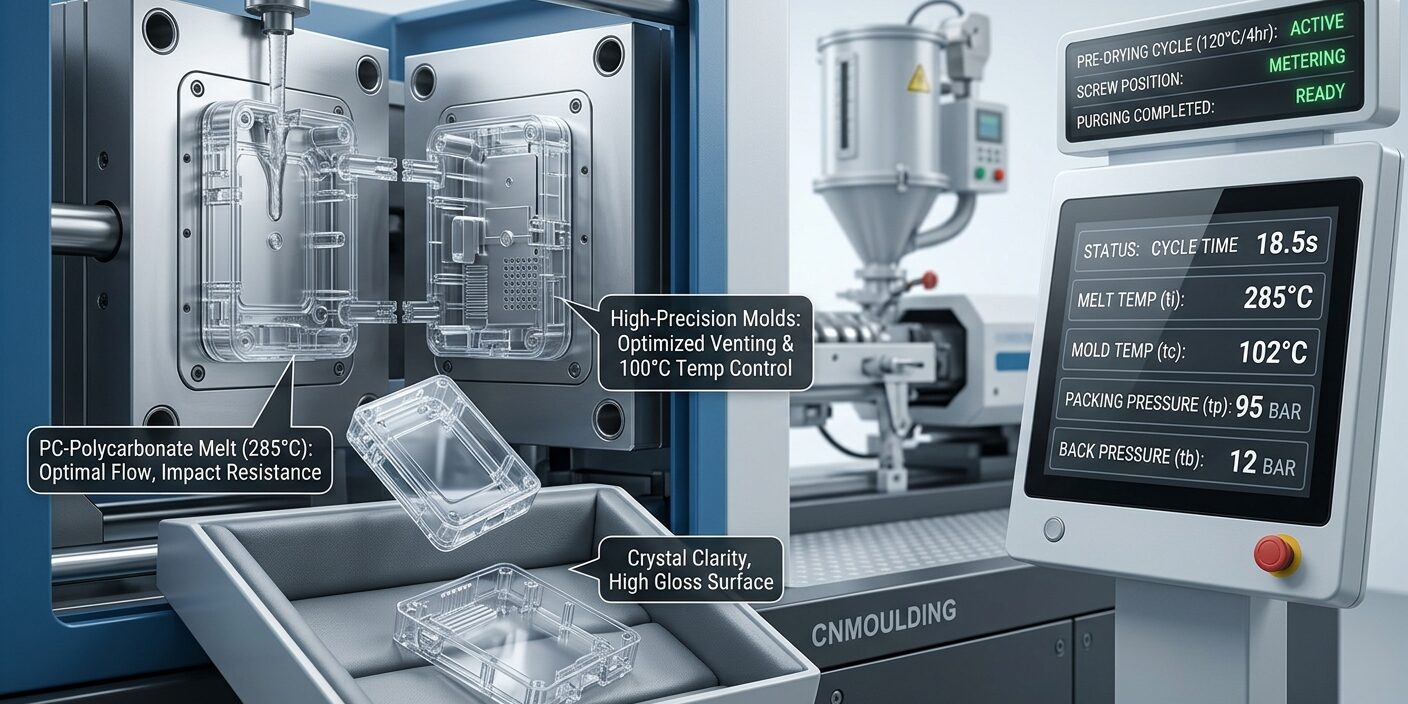
Unfilled Virgin PC: Pre-dry in a dehumidifying desiccant dryer at 120°C (248°F) for at least 4 hours.
Modified / Alloy PC (e.g., PC/ABS): Pre-dry at 110°C (230°F) for 4–6 hours.
Maximum Allowance: Total drying time should not exceed 10 hours. Perform an air shot (purge test) prior to production to confirm melt clarity and moisture-free consistency. Re-reground material can be blended up to 20% for standard components, provided it is clean and free of color masterbatch contamination.
2. Injection Molding Machine & Screw Selection
Due to PC’s high melt viscosity and processing temperatures ($260\text{°C}$ to $310\text{°C}$), selection of the plasticizing screw and barrel is critical:
Bimetallic Wear-Resistant Screws: For flame-retardant or glass-filled PC grades, choose corrosion-resistant and abrasion-resistant bimetallic screws and nozzles to handle corrosive additive off-gassing and glass fiber wear.
Check Valve Integrity: Ensure a precision non-return valve is fitted to prevent backflow during high packing pressures.
3. Mold Temperature & Gate Design
Mold surface temperature directly dictates internal stress, surface finish, and weld line strength:
Standard Mold Temperature: Maintain between 80°C and 100°C. For glass-fiber-reinforced grades, increase mold temperature to 100°C–130°C to push fibers away from the cavity surface and eliminate cosmetic surface float.
Gate Dimensioning: Gates should be generous in size—ideally 70% of the maximum part wall thickness—to prevent excessive shear stress, gas burning, and blush marks. Sub-gates, edge gates, and direct sprue gates are widely used.
Venting: Mold venting depth must be maintained around 0.02 mm to 0.04 mm to prevent air traps and burn marks. Draft angles should be designed at 0.5° to 1.5° minimum.
4. Melt Temperature & Injection Speed
Melt Temperature Range: Standard unfilled PC processes best between 270°C and 310°C. Low-molecular-weight or modified PC blends process at 230°C to 270°C.
Injection Speed: Multi-stage injection speeds (slow-fast-slow) are recommended. Fast initial injection speeds fill thin-walled geometries quickly to prevent premature freezing, followed by a slower speed at the end of the stroke to avoid flash and jetting.
5. Back Pressure & Screw Speed
Maintain a moderate back pressure of 5 to 15 bar to ensure uniform plasticization and eliminate trapped air without generating excessive shear heat.
6. Residence Time & Barrel Purging Protocols
Preventing Thermal Degradation: Extended residence time inside a hot barrel will cause PC to yellow, break down molecular chains, and emit carbon dioxide gas.
Proper Barrel Cleaning: NEVER use POM (Acetal), PVC, PA (Nylon), or LDPE to purge a barrel containing PC, as thermal decomposition and violent degradation can occur. Always use high-molecular-weight Polystyrene (PS), Acrylic (PMMA), or specialized PC purging compounds to clean the barrel.
Partner with CNMOULDING for Precision PC Component Injection
As an ISO 9001:2015 and ISO 13485 certified precision injection mold manufacturer in Shanghai, CNMOULDING possesses extensive experience in processing technical PC, PC+GF, and medical-grade transparent PC resins.
Advanced DFM & Stress Analysis: We optimize wall thickness transitions and gate locations to eliminate internal stress and optical distortion.
Precision Tooling Engineering: Molds built with S136/NAK80 hardened steel, equipped with conformal cooling and high-efficiency venting.
Controlled Cleanroom & Optical Molding: Ensuring crystal-clear transparency for automotive lenses, light guides, and diagnostic medical housings.
Planning a custom PC injection molding project or troubleshooting surface defects on existing tools?
[ Contact CNMOULDING Engineering Team Today ] for a free DFM review and instant quote.