
Understanding Cycle Time in Injection Molding: Optimization & Cost Efficiency
In plastic injection molding, cycle time refers to the total duration required to complete one full molding sequence—from the moment the mold closes to the moment it opens, ejects the finished component, and closes again for the next cycle.
Cycle time is a vital engineering metric because it directly dictates production efficiency, machine utilization, and per-part manufacturing costs. Since cooling and processing time accounts for the largest portion of unit cost, optimizing cycle time while maintaining strict dimensional quality is a primary goal in high-volume manufacturing.
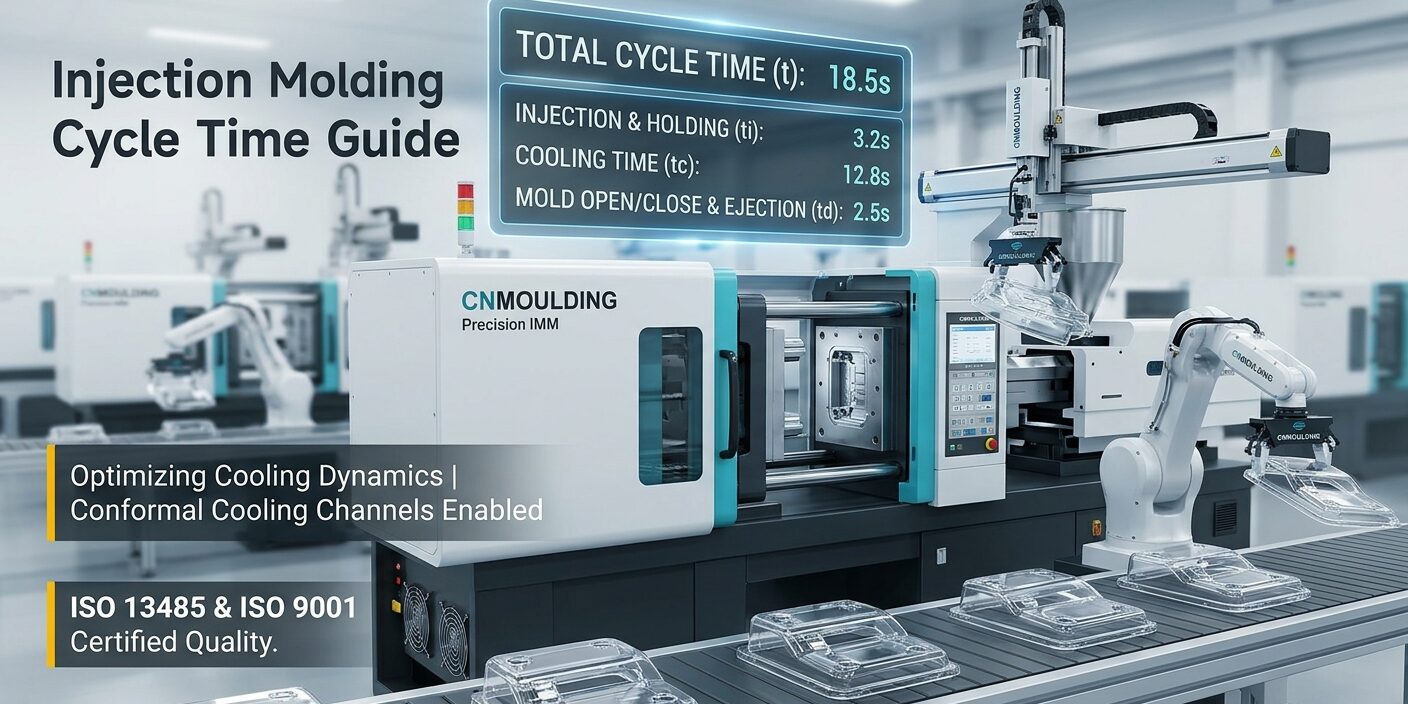
The Total Injection Molding Cycle Time Formula
The total molding cycle time ($t$) can be calculated using the standard engineering formula:
Where:
t_d (Dry Cycle & Handling Time): The intermediate time required to close the mold, open the mold, actuate ejector pins, remove the finished part (via automated robot or gravity drop), load inserts (if overmolding), and spray mold release agent if required.
t_i (Injection & Holding Time): The time required for the screw to inject molten resin into the mold cavity (filling) plus the residence time under packing pressure to prevent sink marks and voids.
t_c (Cooling Time): The crucial duration required for the molten polymer inside the cavity to solidify sufficiently so that ejector pins can release the component without causing warping or pin push-through marks.
Breakdown of Key Molding Stages
1. Injection Time ($t_i$)
Injection time consists of two distinct phases:
Filling Time (3 to 5 seconds): The time taken by the injection screw moving forward to rapidly push plasticized melt into the mold cavity. High-viscosity or thin-walled parts require fast injection speeds to avoid short shots.
Holding/Packing Time (20 to 120+ seconds): Once filled, sustained packing pressure feeds additional melt into the cavity to offset volumetric shrinkage as the part cools. Simple, thin-walled parts require short packing times, whereas thick-walled structural housings may require longer holding times.
2. Cooling Time ($t_c$)
Cooling is the longest single phase in the molding sequence, often accounting for 60% to 70% of the total cycle time.
Cooling duration depends heavily on wall thickness, resin thermal conductivity, mold temperature, and cooling channel layout.
Standard cooling times range from 15 to 120 seconds. The engineering objective is to achieve stable part rigidity for ejection in the shortest time possible.
3. Dry Cycle & Ejection Time (t_d)
Includes high-speed mechanical clamping unit movements, core-pulling retraction, and robotic part retrieval.
Modern automated setups equipped with 3-axis servo robots minimize part pickup time to just 2–5 seconds per cycle.
How CNMOULDING Reduces Cycle Time to Lower Your Part Costs
At CNMOULDING in Shanghai, we optimize injection cycle times starting at the initial mold design stage to ensure maximum cost competitiveness for our clients:
Conformal Cooling & Optimized Channel Layouts: We engineer high-efficiency cooling channels positioned precisely around thick part sections to maximize heat transfer and cut cooling times by up to 30%.
DFM Wall Thickness Uniformity: During early DFM analysis, our engineers recommend wall thickness adjustments to eliminate heavy mass areas that bottleneck cooling cycles.
High-Speed Fully Automated Production: Our state-of-the-art horizontal and vertical presses utilize high-speed servo-robots for automated part extraction and 24/7 continuous operation.
Looking to reduce production cycle times or optimize your existing tooling for mass production?
[ Contact CNMOULDING Engineering Team Today ] for a comprehensive DFM review and cost analysis.