

Multi-Cavity Two-Shot Injection Molds: Flow Balance, Thermal Management, and Dimensional Stability
Injection Mold Manufacturing Services in China
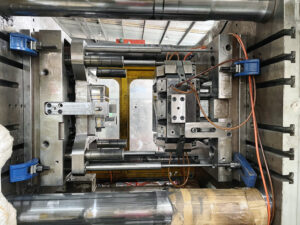
Scaling a two-shot (2K) component from a single-cavity prototype tool to a multi-cavity production mold compounds mechanical and thermal complexity. In a multi-cavity two-shot mold, every cavity must achieve identical fill timing across two separate injection stages while maintaining micron-level registration between the rotating core side and both stationary cavity halves. Achieving this requires disciplined runner geometry, isolated thermal circuits, and ultra-tight toolroom machining tolerances.
Geometrically Balanced Runner & Hot Runner Systems
Unlike single-shot molds where melt delivery is balanced once, a multi-cavity two-shot mold requires two independent, precisely balanced feed systems:
Naturally Balanced Runner Layouts: Whether utilizing cold sub-runners or heated manifolds, both Shot 1 and Shot 2 feed paths are engineered with identical flow lengths, turn radii, and cross-sectional diameters (typically an H-type or star layout for 4+4 and 8+8 cavity tools). Equalized pressure drop ensures that all first-shot substrates reach the exact same density and shrinkage state before indexing into the second station.
Sequential Valve-Gate Hot Runners: For large multi-cavity 2K molds or components with thin-wall ribs, hot runner manifolds equipped with pneumatic or hydraulic sequential valve pins allow toolmakers to tune gate opening timing per cavity, eliminating weld-line entrapment and gate vestige variation without extending cycle time.
Tooling Machining Precision & Index Repeatability
When multiple cavities index simultaneously on a 180° rotary platen, cumulative machining stack-up error is the primary cause of uneven flash or substrate crushing:
Cavity-to-Core Positional Accuracy: All cavity inserts, core inserts, and rotary index locating plates are finish-machined on 5-axis CNC machining centers and wire-cut EDM to hold pocket-to-pocket pitch tolerances within ±0.005 mm and overall rotary alignment within .
Hardened Shut-Off Lands & Micro-Venting: Multi-cavity 2K molds experience higher clamping loads across larger projected areas. Shut-off inserts are machined from through-hardened tool steel (H13 or S136 at 52–58 HRC) with calibrated crush clearances (0.03–0.05 mm0.03\text{–}0.05\text{ mm}) and precision-ground perimeter vents (0.012–0.015 mm deep) to prevent air traps at the material interface.
Parallel Zoned Cooling Circuits: Series cooling across multiple cavities creates progressive heat buildup from inlet to outlet. Multi-cavity 2K molds are gun-drilled with parallel, baffled cooling loops dedicated separately to Shot 1 and Shot 2 inserts so each cavity maintains uniform steel temperature across the entire mold base.
Toolmaking Case Study: 4+4 Cavity Rotary Two-Shot Mold for Precision Sensor Housings
We designed and built a 4+4 cavity rotary two-shot injection mold for an automotive sensor housing combining a glass-filled PA66-GF30 structural body with an overmolded TPU perimeter sealing lip. Critical part specifications required bore concentricity within ±0.020 mm and zero flash along the stepped sealing groove across all four cavities.
Tooling Challenges:
Stack-Up Error Across 8 Cavities: Across four Shot 1 cavities and four Shot 2 cavities, even minor pitch deviations between the moving cores and stationary plates risked causing uneven seal crush on outer cavities.
Differential Thermal Expansion: Shot 1 operated at a higher mold steel temperature (85 °C) for glass-filled nylon, while Shot 2 required cooler steel (45°) for clean TPU release.
Toolroom Execution & Verification:
Datum-Referenced Jig Grinding & Wire EDM: All eight cavity pockets and four moving core nests were referenced to a single master datum on the mold base, using precision wire EDM and jig grinding to hold inter-cavity pitch accuracy within .
Thermal Barrier Plates & Parallel Manifolds: Insulating plates and dedicated water manifolds were machined into the mold base to thermally isolate the Shot 1 and Shot 2 halves, preventing heat bleed across the parting plane.
Pre-T1 CMM & Blue-Transfer Inspection: Prior to press trials, every core and cavity insert underwent full CMM verification, followed by high-spot blue-transfer spotting across all four shut-off lands to confirm uniform contact before T1 sampling.
During T1 qualification runs, all four cavities filled uniformly on the initial short-shot progression check and produced flash-free, dimensionally compliant parts without requiring post-trial steel rework.