
Injection Molding Sink Marks: Causes, Prevention, and Real Factory Solutions
Sink marks are one of the most common quality problems in plastic injection molding. These small surface depressions may look minor at first glance, but they can seriously affect the appearance and performance of a product.
For manufacturers producing consumer electronics, automotive components, or medical devices, even small sink marks can lead to product rejection or customer complaints.
At CNMOULDING (Shanghai), a plastic injection mold manufacturer established in 1997, we frequently help customers solve molding defects during product development and mass production. With more than 25 years of experience in mold manufacturing and injection molding services, we have encountered many sink mark issues across different industries.
In this article, we explain what sink marks are, why they occur, and how they can be prevented, along with a real case study from our factory.
What Are Sink Marks in Injection Molding
Sink marks are small depressions or dimples that appear on the surface of molded plastic parts. They typically occur in thicker areas of the part where the material cools unevenly.
These defects usually appear:
near ribs
around screw bosses
in thick wall sections
close to structural supports
Sink marks are caused by plastic shrinkage during the cooling process.
When molten plastic cools inside the mold cavity, it shrinks. If the outer surface of the part cools faster than the inner material, the internal shrinkage pulls the surface inward, creating a visible depression.
While sink marks are often cosmetic defects, they can also indicate structural design problems in the part or mold.
Why Sink Marks Occur in Injection Molding
Several factors can cause sink marks during injection molding production.
Understanding these causes is the first step toward solving the problem.
1 Uneven Wall Thickness
One of the most common causes of sink marks is uneven wall thickness.
When a plastic part contains thick sections next to thin sections, cooling occurs at different speeds. Thick areas remain hot longer, and the material inside continues to shrink while the outer surface has already hardened.
This internal shrinkage pulls the surface inward, forming sink marks.
Engineering Recommendation
Product designers should aim for uniform wall thickness whenever possible. If thicker structural areas are necessary, techniques such as coring or rib design optimization should be used.
2 Improper Rib or Boss Design
Ribs and screw bosses are often required to strengthen plastic parts, but poor design can easily cause sink marks.
If a rib or boss is too thick compared to the main wall thickness, the additional material increases shrinkage during cooling.
A common guideline used by mold designers is:
rib thickness should be 50%–70% of the main wall thickness
Following this rule helps reduce the risk of visible sink marks on the surface.
3 Insufficient Packing Pressure
After the mold cavity is filled, holding pressure (packing pressure) is applied to compensate for material shrinkage during cooling.
If packing pressure is too low or holding time is too short, there will not be enough material to compensate for shrinkage.
As a result, sink marks may appear on the surface of the molded part.
Solution
Optimizing holding pressure and holding time can significantly reduce sink marks in many cases.
4 Poor Mold Cooling Design
Cooling is one of the most critical factors in injection molding.
If cooling channels are poorly designed, some areas of the mold may cool much slower than others.
This uneven cooling creates differential shrinkage and increases the likelihood of sink marks.
Solution
Proper cooling channel design ensures uniform temperature distribution across the mold cavity.
In many modern projects, conformal cooling design or optimized cooling circuits are used to improve cooling efficiency.
Real Case Study: Consumer Electronics Housing
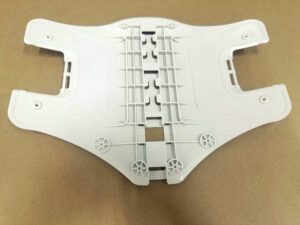
One of our customers, a consumer electronics manufacturer from North America, contacted us regarding a sink mark issue on a plastic housing component.
The part was designed for a smart home device and required excellent cosmetic quality because it was visible to end users.
Project Details
material: ABS
wall thickness: 2.0 mm
part type: electronic housing
annual production volume: 1.8 million units
Problem Description
During trial production, visible sink marks appeared around several screw bosses on the outer surface of the housing.
Although the defect did not affect product functionality, it failed the customer’s visual quality requirements.
Engineering Analysis
Our engineering team conducted a full DFM (Design for Manufacturing) analysis and Moldflow simulation.
The analysis revealed two major issues:
The screw boss thickness was 3.2 mm, which was significantly thicker than the surrounding wall thickness.
The cooling channels near the boss area were not optimized.
These two factors caused uneven cooling and excessive shrinkage near the boss structures.
Our Engineering Solution
To solve the problem, our engineers implemented several improvements.
1 Boss Coring Optimization
We modified the screw boss design by adding internal coring to reduce material thickness.
This adjustment maintained structural strength while reducing shrinkage risk.
2 Cooling System Optimization
Additional cooling channels were added near the critical area to improve heat removal during the cooling stage.
3 Process Parameter Adjustment
Injection molding parameters were optimized, including:
increased holding pressure
extended holding time
adjusted melt temperature
Final Results
After implementing these changes, the results were significantly improved.
sink marks were completely eliminated
surface quality met customer cosmetic standards
cycle time was reduced by 6 seconds
The customer successfully moved into mass production and later partnered with us on additional mold projects.
Best Practices to Prevent Sink Marks
Based on our experience from hundreds of injection molding projects, preventing sink marks requires collaboration between product designers, mold designers, and process engineers.
Key recommendations include:
Maintain Uniform Wall Thickness
Consistent wall thickness helps ensure uniform cooling and reduces shrinkage differences.
Optimize Rib and Boss Design
Following proper design guidelines prevents excessive material buildup in localized areas.
Use Moldflow Simulation
Simulation software can predict shrinkage behavior before the mold is manufactured.
Improve Cooling Channel Layout
Efficient cooling design ensures even temperature distribution across the mold.
Optimize Injection Molding Parameters
Proper packing pressure and holding time help compensate for material shrinkage.
Why Work With an Experienced Mold Manufacturer
Sink marks may appear simple, but solving them often requires deep experience in mold design, material behavior, and injection molding processes.
At CNMOULDING (Shanghai), we combine decades of engineering expertise with modern manufacturing technology.
Our capabilities include:
precision injection mold manufacturing
injection molding production
DFM and mold design optimization
defect analysis and troubleshooting
Our company operates under ISO9001 quality management standards and ISO13485 certification for medical device manufacturing, ensuring consistent quality and strict production control.
Need Help Solving Injection Molding Defects?
If your project is experiencing sink marks, warpage, flash, or other molding defects, our engineering team can help analyze the problem and provide practical solutions.
With more than 25 years of mold manufacturing experience, CNMOULDING supports customers worldwide with reliable tooling and production services.
Contact our Shanghai engineering team today to discuss your project and receive professional support.