


6 Engineering Strategies to Slash Injection Molding Costs Without Sacrificing Quality
In injection molding, the cost of the mold is just the tip of the iceberg. The real expenses—labor, cycle time, material waste, and maintenance—lie beneath the surface. To truly reduce costs, we must look at the entire lifecycle of the part.
At our Shanghai facility, we focus on “Value Engineering.” Here are 6 proven ways to optimize your production costs from a manufacturer’s perspective.
1. Optimize Wall Thickness (The 10% Rule)
One of the most common technical “pain points” is uneven wall thickness.
The Cost Driver: Thick sections take exponentially longer to cool. If one area of your part is 2mm thicker than the rest, the entire machine waits for that one spot to solidify, burning money every second.
The Solution: Keep walls uniform. Reducing wall thickness by just 10% can sometimes yield a 25% improvement in cycle time. It also prevents “sink marks” and warping, reducing your scrap rate.
2. DFM: Eliminate the “Expensive” Features
Before we cut steel, we perform a Design for Manufacturing (DFM) analysis.
The Cost Driver: Undercuts, deep ribs, and sharp internal corners. These require expensive “sliders” (moving parts in the mold) or slow EDM (Electrical Discharge Machining) processes.
The Solution: Use “Draft Angles” (slopes) to allow the part to eject easily. If you can redesign an undercut into a “bridge” or a “pass-through,” you can eliminate a slider entirely, saving thousands in mold construction.
3. Choose the Right Runner System (Cold vs. Hot)
Many customers choose cold runners because the mold is cheaper, but this is often a mistake for high-volume projects.
The Cost Driver: Every time the mold opens, the “runner” (the plastic path to the part) becomes waste. In some cases, the runner weighs more than the part itself!
The Solution: For high-volume medical or consumer parts, invest in a Hot Runner system. It eliminates waste and significantly reduces cycle time. The initial cost is higher, but the ROI is often achieved within the first few months of production.
4. Multi-Cavity Scaling: The Math of Efficiency
The Cost Driver: Running a single-cavity mold on a large machine is a waste of energy and overhead.
The Solution: Scale wisely. Moving from a 2-cavity mold to an 8-cavity mold doesn’t quadruple the price, but it dramatically lowers the “price per part.” We help you calculate the “sweet spot” where the mold cost and production volume intersect for maximum profit.
5. Standardize Your Mold Bases
The Cost Driver: Custom-sized mold bases require unique machining and specialized spare parts.
The Solution: Wherever possible, use standard mold bases (like DME or LKM standards). This allows us to use off-the-shelf components for pins, bushings, and cooling connectors. It lowers the initial build cost and makes future maintenance much faster and cheaper, regardless of where the mold is running.
6. Maintenance-Friendly Design
The Cost Driver: Unexpected downtime. If a mold has to be pulled from the machine for a 5-cent O-ring failure, you lose hours of production.
The Solution: We design molds with “Easy-Access” cooling and ejection. By placing high-wear components in accessible areas, we reduce “Mean Time to Repair.” A mold that stays in the machine longer is a mold that makes more money.
The CNMOULDING Conclusion: Think Beyond the Quote
Reducing cost isn’t about finding the cheapest steel; it’s about reducing the cost of the “Shot.” By optimizing the design, cooling, and cycle time at our Shanghai facility, we ensure that your product is competitive on the global stage.
Precision is our pulse. Efficiency is your profit.
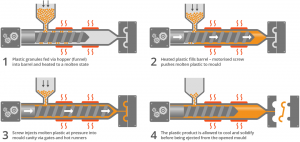
6 Ways to Reduce Your Injection Molding Costs


